
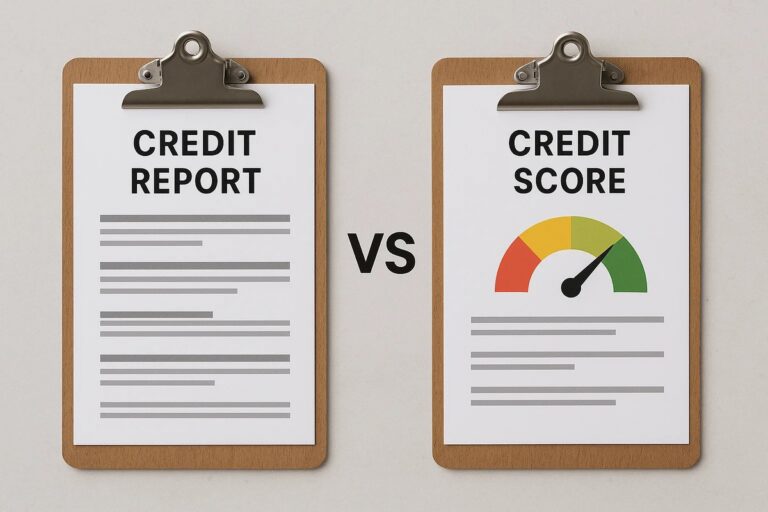
Credit report vs credit score difference is one of the most important concepts for anyone learning how to build a healthy financial life. Understanding how these two tools work helps consumers make informed decisions, avoid mistakes and strengthen their overall credit profile. Although they are closely related, each one serves a unique purpose in the credit evaluation process.
Many young adults and beginners wonder why lenders sometimes examine a full report instead of relying only on the numerical score. This guide explains how each element functions, what information appears in your report, how scores are calculated, why both matter for approvals and how to check and improve your credit profile with confidence.
Credit report vs credit score: what’s the difference?
The credit report is a detailed document that compiles your complete credit history, while the credit score is a numerical indicator produced from the data contained in that report. The report provides depth and context, and the score provides a simplified overview of your creditworthiness.
Credit bureaus such as Experian, Equifax and TransUnion collect and update the information that forms your credit report. Models like FICO and VantageScore analyze those details to generate your score. Since the score depends entirely on the report, any change in data affects both elements.
Understanding the credit report vs credit score difference is essential because many consumers attempt to improve the score without reviewing the accuracy of the report. Incorrect information can lower the score even when financial behavior is responsible.
What information appears on your credit report
A credit report includes open and closed accounts, payment history, loan balances, credit limits, collection accounts, public records and inquiries from lenders. These details show how you manage credit over time and help institutions determine your financial reliability.
Credit bureaus receive updates from lenders whenever there is new activity, which means the report grows and changes along with your financial behavior. Because each bureau may have slightly different data, checking all three ensures that your information remains accurate and complete.
This document is often used for deeper evaluations, since it offers insights into long term patterns, consistency of payments and the evolution of your credit usage.
How your credit score is calculated
Your credit score is calculated using models that interpret categories of financial behavior. These categories typically include payment history, credit utilization, length of credit history, credit mix and recent inquiries. Among these, payment history and utilization are usually the most influential.
A consistent record of on time payments strengthens your score, while high utilization may negatively impact it. The mix of credit types, such as credit cards, installment loans or mortgages, also contributes to your score. Each update in your credit report triggers a recalculation of the score, which means monitoring the report is essential to maintaining a strong rating.
To reinforce these distinctions, the table below summarizes the main differences between the report and the score.
| Element | Credit report | Credit score |
| Content | Full credit history with detailed records | Numerical evaluation of credit risk |
| Origin | Experian, Equifax and TransUnion | FICO, VantageScore and similar models |
| Purpose | Provide deep insight into financial behavior | Offer a simplified risk indicator |
| Update frequency | Updated when lenders report new data | Recalculated whenever report information changes |
| Main use | Thorough risk assessment | Quick screening for approvals |
Why both matter for loan and credit approval
Lenders rely on both tools because each one provides different types of information. The credit score offers a quick estimate of risk, while the credit report offers a deeper view of your real financial habits. A strong score increases your approval chances, but lenders may still examine the full report when evaluating mortgages, refinancing requests or credit limit increases.
If your report contains inaccurate late payments, unfamiliar accounts or outdated data, lenders may hesitate even if your score appears strong. This makes maintaining an accurate and up to date report just as important as building a high score.
Both tools work together and influence interest rates, financing options and access to better credit products.
How to check and improve your credit profile
Consumers can access their credit report for free once a year from each major bureau. Many financial institutions also provide free access to a credit score, allowing you to track improvements regularly. Monitoring both resources ensures that you stay informed and identify inconsistencies early.
Errors in your report can significantly affect your score. Incorrect late payments, duplicated accounts or fraudulent activity may reduce your score and impact approval chances. Each bureau offers a dispute process, and once information is corrected, your score updates automatically.
Improving your credit profile requires habits such as paying bills on time, keeping credit utilization low, maintaining long term accounts and avoiding unnecessary inquiries. Following these practices consistently strengthens both your report and score.
Understanding the credit report vs credit score difference empowers consumers to build a stable financial foundation, monitor progress effectively and access better financial opportunities.
👇 Other content you may be interested in:
- Select Best personal loan Lenders: compare top options for 2025
Best personal loan Lenders: compare top options for 2025 - Credit Card vs Debit Card: Key Differences Explained
- Best secured credit cards for bad credit: build your score safely